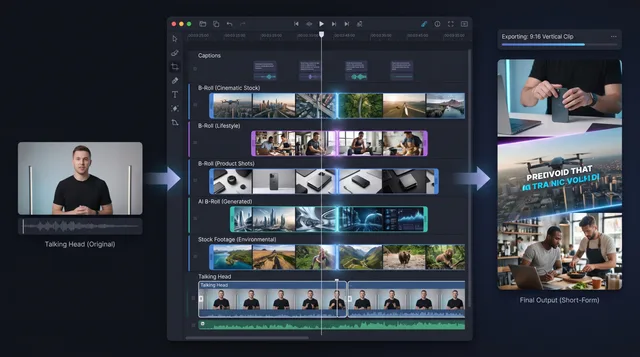
AI finds viral moments by reading your transcript, audio energy, and visuals, then scoring segments on hook strength, emotional intensity, and narrative completeness against patterns from past top clips. It ranks and diversifies the best candidates. To improve results, front-load hooks, use topic prompts, adjust clip length, and trim boundaries by hand.
Drop an hour-long podcast or stream into a clipping tool and something interesting happens behind the scenes: the system watches, listens, reads, and scores every second before handing you a shortlist. AI viral clips aren't picked by magic or by a single "virality" number. They come from several models running at once, each measuring a different signal. Understanding that pipeline is the fastest way to get better cuts.
This article explains how the logic works, why the AI sometimes skips your favorite moment, and what you can do to steer it toward the clips you actually want.
What the AI is actually analyzing
Modern clipping engines don't "understand" your video the way you do. They turn it into layers of structured data and hunt for patterns tied to engagement. Most tools blend the following inputs.
The transcript layer
Speech-to-text is the backbone of nearly every clipping tool. Once your audio becomes text with word-level timestamps, the AI runs language models over it to find:
- Complete thoughts — segments with a clear beginning and payoff, not sentences cut mid-idea.
- Hooks and questions — openers like "Here's the thing nobody tells you..." that create an information gap.
- Emotional or opinionated language — strong claims, surprise, humor, and contrarian takes tend to score higher.
- Keyword density — topical clusters that point to a self-contained subject.
The transcript explains why a clean, well-spoken segment often beats a visually exciting but rambling one. If the language model can't find a coherent arc in the text, the moment rarely surfaces.
The audio layer
Words aside, the raw audio carries signal. Tools measure volume dynamics, pitch shifts, laughter, pauses, and pace. A sudden spike in energy — a raised voice, a guest laughing, a dramatic silence before a punchline — flags a possible emotional peak. That's why reaction moments cluster near the clips the AI recommends.
The visual layer
Computer vision adds another dimension. Depending on the tool, it may track:
- Face presence and count (single-speaker moments are easier to reframe vertically)
- Scene changes and camera cuts
- On-screen text or slides
- Movement and gesture intensity
Visual analysis mainly supports smart video clipping by helping the tool crop and reframe intelligently, but it also shapes selection. A talking head staring flatly at the camera scores differently than an animated, gesturing speaker.
How AI viral clips get scored and ranked
Once the signals are extracted, the system gives each candidate segment a composite score. Think of it as a weighted sum, not one metric.
| Signal | What it rewards | Why it matters for virality |
|---|---|---|
| Hook strength | A compelling first 3 seconds | Determines watch-through on short platforms |
| Narrative completeness | Self-contained payoff | Viewers finish the clip |
| Emotional intensity | Laughter, surprise, conviction | Drives shares and comments |
| Topical clarity | One focused subject | Improves discoverability and captions |
| Length fit | 15–60s target windows | Matches platform sweet spots |
The algorithm then ranks candidates and often groups overlapping segments so it won't hand you five near-identical cuts of the same story. The final shortlist balances raw score against diversity.
The role of hook detection
Most tools weight the opening seconds heavily because platform retention curves are brutal in the first three seconds. Auto clip selection engines hunt specifically for lines that can stand alone as a first sentence — a bold claim, a question, a number, or a moment of tension. Bury a great insight after 40 seconds of setup and the AI may skip it entirely or start the clip mid-thought, which is a common source of frustration.
Training data and what "viral" means to the model
Here's the part creators often miss: the model's definition of viral comes from the data it trained on. If a tool learned from millions of high-performing short clips, its scoring reflects the patterns in that dataset — fast hooks, tight pacing, emotional spikes. That's powerful for generic content, but it means niche or slow-burn material can be undervalued. The AI isn't wrong; it optimizes for the average, and your channel may not be average.
Why the AI misses your favorite moment
Every creator has been there: the tool ignored the moment you knew was gold. Usually one of these is the culprit.
- The insight lacked a verbal hook. You understood the context; the transcript didn't carry it.
- The payoff depended on visuals the vision model didn't prioritize, like a screen share or a physical demo.
- The moment spanned a topic shift, so the segmentation logic split it awkwardly.
- It was too quiet. Great ideas delivered in a calm, even tone don't trigger the emotional-intensity signal.
- It was too long to fit the target window without trimming the setup.
None of these mean the AI failed. They mean the signals it reads didn't match the value you saw. That gap is exactly where your input matters.
How to guide AI toward better cuts
Smart video clipping works best as a collaboration. You bring context the model can't infer; the tool brings speed and pattern recognition. Here's how to steer it.
1. Front-load your hooks while recording
The single biggest lever is upstream. When you're about to make a strong point, state the conclusion first, then explain. "Most creators post at the wrong time — here's why" gives the AI a clean hook and a complete arc to detect. You're basically writing captions for the algorithm in real time.
2. Use keywords and prompts if your tool supports them
Many platforms now let you describe what you want: "funny moments," "clips about pricing," "emotional stories." This reweights auto clip selection toward your intent instead of the default virality model. Be specific — topical prompts beat vague ones.
3. Adjust length and format settings
If your best content needs room to breathe, raise the maximum clip length. If you're feeding platforms that reward speed, tighten it. The target window directly changes which segments qualify, so don't accept defaults blindly.
4. Edit the in and out points
Almost every tool lets you drag the clip boundaries. When the AI starts a clip mid-thought, extend the front to capture the setup. This one habit fixes the most common complaint about automated clipping and takes seconds.
5. Feed it cleaner input
Garbage transcript, garbage clips. Good microphone audio improves speech-to-text accuracy, which improves every downstream decision. Cutting crosstalk and background noise measurably raises the quality of AI viral clips, because the language model finally sees what you actually said.
6. Rate and re-run
Some tools learn from your thumbs-up/thumbs-down feedback or let you regenerate with new parameters. Treat the first pass as a draft. If the shortlist feels off, change one variable — length, topic prompt, or number of clips — and run again instead of fighting the whole result.
A realistic mental model for creators
It helps to stop thinking of the AI as a taste-maker and start seeing it as a very fast, very literal assistant. It reads the transcript, listens for energy, watches for faces, scores against patterns of past hits, and returns the segments that check the most boxes. It has no memory of your brand, no sense of your audience's inside jokes, and no idea which offhand comment your community will meme for a week.
That's not a weakness to work around; it's a division of labor. The tool handles the tedious work of scrubbing through hours of footage to find candidates. You supply the judgment, context, and final trim. When creators get disappointing results, it's almost always because they expected the AI to make editorial decisions it was never designed to make.
Where the technology is heading
The next generation of clipping tools is shifting from single-signal scoring toward multimodal models that reason across text, audio, and video at once — closer to how a human editor sizes up a moment. They're also getting better at personalization, learning your channel's specific winners over time rather than relying purely on generic virality training. As that improves, the gap between what the AI picks and what you'd pick will shrink, but your context will still be the deciding edge.
Key takeaways
- AI viral clips come from a pipeline: transcript analysis, audio energy, visual cues, and a weighted scoring model — not one magic metric.
- Hooks and complete narrative arcs matter most; buried insights and quiet delivery get overlooked.
- The model's idea of "viral" reflects its training data, which favors fast, emotional, self-contained content.
- You steer smart video clipping by front-loading hooks, using topic prompts, adjusting length, and trimming boundaries by hand.
- Treat auto clip selection as a fast first draft and apply your editorial judgment on top.
The creators who get the most from automated clipping aren't the ones with the best tool — they're the ones who understand what the tool is measuring and record and configure accordingly. Once you know the logic, you stop fighting the algorithm and start feeding it exactly what it's built to find.