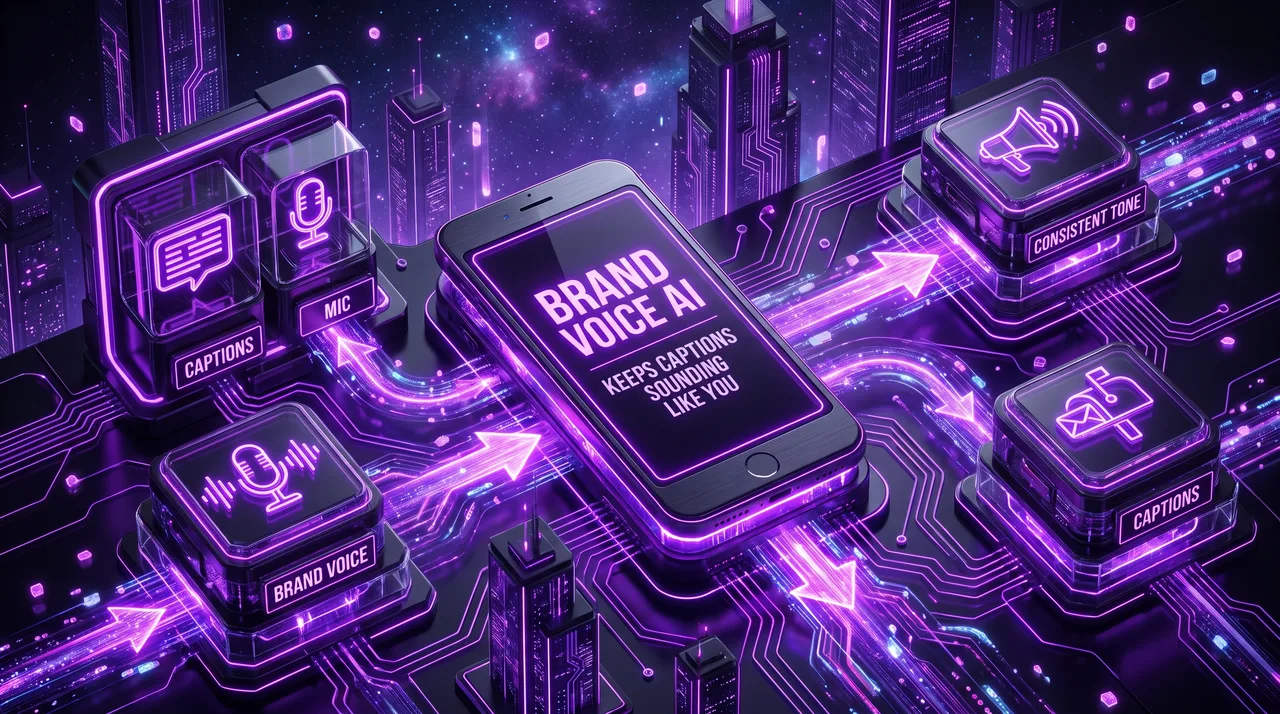
TL;DR: Brand voice AI saves a reusable profile of your tone, vocabulary, formatting rules, and real caption examples, then injects it into every generation request. That context shapes each caption before a word is written, keeping AI-generated posts sounding consistently like your brand across channels, formats, and team members.
Every brand has a way of speaking. Maybe you're playful and lowercase, maybe you're precise and formal, maybe you drop a wink of dry humor into otherwise buttoned-up posts. That voice is an asset — and the fastest way to erode it is to let generic AI write your captions. Brand voice AI solves that problem by learning how you write before it writes a single word on your behalf.
This article breaks down what a saved brand voice actually is, how it shapes generated captions and posts, and how small teams and agencies can use it to protect tone across dozens of accounts without babysitting every draft.
What Brand Voice AI Actually Does
A plain large language model writes in a competent, average, slightly bland style — the statistical middle of everything it has read. That's why untuned AI captions so often feel interchangeable. They're grammatically fine and completely forgettable.
Brand voice AI adds a layer on top of that raw capability. Instead of asking the model to "write a caption," you give it a persistent profile that says this is who is speaking. The profile travels with every request, so the output bends toward your identity rather than the internet's average.
Think of it as the difference between hiring a freelancer who has never seen your brand and briefing a copywriter who has read your last hundred posts. Same skill, wildly different results.
The signals a voice profile captures
A good voice profile encodes more than "friendly" or "professional." It captures the concrete, repeatable choices that make writing recognizable:
- Tone and attitude — warm, authoritative, cheeky, empathetic
- Formality level — contractions and slang versus polished sentences
- Sentence rhythm — short punchy lines or flowing, detailed paragraphs
- Vocabulary — words you love and words you never use
- Formatting habits — emoji usage, hashtag style, line breaks, capitalization
- Point of view — first person "we," second person "you," or brand-as-narrator
Each of these is a small dial. Set them once and every future caption inherits the settings.
How a Saved Voice Shapes Every Generated Caption
When you save a brand voice, you're creating a reusable instruction set that gets injected into the model at generation time. Here's what happens under the hood, in plain terms.
1. Your rules become part of the prompt
Before your topic ever reaches the model, the system prepends your voice profile. The model doesn't just see "announce our summer sale" — it sees "announce our summer sale, written by a brand that is upbeat but never pushy, uses one emoji max, addresses the reader as 'you,' and avoids exclamation points."
That context changes the output before a single word is generated.
2. Examples anchor the style
The strongest voice profiles include real samples of your past writing. A handful of your best-performing captions teaches the AI your rhythm far better than adjectives can. This is why pasting in three or four on-brand posts often does more than a long list of instructions.
3. Guardrails prevent drift
A saved voice can also carry a do-not list: banned phrases, off-limits topics, competitor names, or tone traps to avoid. These guardrails catch the moments where a model might otherwise wander — the stray hashtag spam, the overenthusiastic sales language, the corporate cliché you've spent years training your team to avoid.
Why Consistent Brand Tone Matters More Than You Think
A single off-key caption rarely sinks a brand. The damage from inconsistency is cumulative. When your Monday post sounds like a startup founder and your Thursday post sounds like a legal disclaimer, audiences feel the seam even if they can't name it. Trust erodes quietly.
Consistent brand tone is what makes a follower recognize your post in a crowded feed before they see your logo. It's the reason someone forwards your caption to a colleague and says "this is so them." That recognition is expensive to build and cheap to lose.
For agencies, the stakes multiply. You might manage voice for a law firm, a skincare line, and a local brewery in the same afternoon. Holding three distinct voices in your head — and keeping every writer on your team aligned — is genuinely hard. Saved voice profiles turn that mental juggling act into a dropdown menu.
| Without saved brand voice | With brand voice AI |
|---|---|
| Tone drifts between writers | One profile enforces the same voice |
| New hires need weeks to "get it" | Voice is documented and reusable |
| Each client voice lives in someone's head | Each client voice is a saved profile |
| Captions reviewed line by line | Reviews focus on facts, not tone |
Building a Voice Profile That Actually Sounds Like You
The quality of your captions depends almost entirely on the quality of your voice setup. A rushed profile produces rushed-sounding output. Here's how to build one that holds up.
Start with your best existing content
Don't describe your voice from scratch — mine it. Pull your ten strongest posts, the ones that felt unmistakably on-brand and performed well. These become both your examples and your reference point when you write descriptions.
Describe the voice in specifics, not adjectives
"Friendly and professional" means nothing to a model because it means something different to everyone. Replace vague adjectives with observable behavior:
- Instead of casual, say "uses contractions and occasional sentence fragments for emphasis."
- Instead of expert, say "makes a confident claim in the first line, then backs it with one specific detail."
- Instead of fun, say "opens with a question or a mild exaggeration, never a pun."
Write down what to avoid
A voice is defined as much by its exclusions as its inclusions. List the phrases that make you cringe, the emoji you've retired, the topics you steer clear of. This negative space keeps AI captions from sliding into templated blandness.
Here's a simple profile structure you can copy and adapt:
BRAND VOICE PROFILE

Who we are: [one-line description of the brand and audience]

Tone: [3-4 specific behaviors, not adjectives]

Formatting:
- Emoji: [max count / allowed / none]
- Hashtags: [style and quantity]
- Length: [target caption length]
- Capitalization: [standard / lowercase / other]

We say: [words and phrases we use]
We never say: [banned words, cliches, competitor names]

Examples:
1. [paste a real, on-brand caption]
2. [paste another]
3. [paste a third]
Test, then refine
Generate five captions and read them as a stranger would. Where the output misses, the fix usually isn't "the AI is bad" — it's a gap in the profile. Add the missing rule, regenerate, and watch the drift disappear. Voice profiles improve fastest when you treat every off-brand caption as a note-to-self.
How Teams and Agencies Scale It
Once a voice is saved, the real payoff arrives: leverage.
One voice, many hands
Junior team members can now produce senior-quality drafts because the voice does the heavy lifting. Your editing shifts from "rewrite this to sound like us" to "check the facts and hit publish." That's a fundamentally faster review cycle.
Multiple voices, one workspace
Agencies can store a separate profile per client and switch between them instantly. The brewery gets its cheeky lowercase energy; the law firm gets its measured authority — and neither bleeds into the other. Brand voice AI makes managing a portfolio of distinct tones a matter of selecting the right profile rather than context-switching by memory.
Consistency across formats
A saved voice isn't limited to Instagram captions. The same profile can shape LinkedIn posts, thread hooks, newsletter blurbs, and video descriptions. When you repurpose one piece of content into six formats, the voice stays intact across all of them — which is precisely where inconsistency usually creeps in.
Common Pitfalls to Avoid
Even with brand voice AI, a few habits will undermine your results:
- Over-describing. A profile crammed with fifty rules confuses the model. Prioritize the five that matter most.
- Skipping examples. Descriptions tell; examples show. Never rely on adjectives alone.
- Never updating. Your voice evolves. Revisit profiles quarterly so they reflect how you actually sound today, not last year.
- Trusting output blindly. AI handles tone well; it still needs a human to verify facts, offers, and dates.
- Using one profile for every channel. Your Twitter voice and your LinkedIn voice may differ. Consider separate profiles when the gap is real.
The Payoff: Scale Without Losing Yourself
The promise of AI captions was always speed. The risk was always sameness — a feed full of technically-correct posts that could belong to anyone. Brand voice AI resolves that tension. You get the volume and pace of automation with the personality that made people follow you in the first place.
The work is front-loaded. Spend an hour building a genuine voice profile, feed it your best examples, and set clear guardrails. After that, every caption you generate arrives already sounding like you — so your team spends its time on strategy and facts instead of endlessly rewriting tone.
That's the quiet advantage: consistent brand tone stops being a thing you enforce post by post and becomes a property of your entire content system. Set the voice once, and let it carry through everything you publish.