Batch your evergreen clips in one focused session for efficiency and a consistency buffer, but keep one or two reactive slots open for timely content. This hybrid model beats pure daily production, protecting quality when your week gets busy while still letting you jump on trends that matter.
Every creator eventually hits the same wall: you need to post short clips consistently, but you only have so many hours in a week. The question that decides whether you burn out or build momentum is deceptively simple — do you make everything in one big session, or do you produce a little every day?
This is the heart of the content batching debate. Batching means concentrating all your filming, editing, and scheduling into a single block of focused time. Daily production spreads the same work across the week. Both can work. Both can fail. The right answer depends on your energy, your niche, and how much your content relies on being timely.
Let's compare them honestly, then build a weekly content plan you can actually stick to.
What content batching actually means
Content batching is the practice of grouping similar tasks together and doing them all at once, instead of switching between them repeatedly. For short clips, a typical batch day looks like this: you script five to ten ideas in the morning, film them back-to-back after lunch, then edit and schedule them in the evening — or over the next day.
The power of batching comes from eliminating context switching. Setting up lights, framing a shot, and getting into "on-camera" energy all carry a startup cost. When you film ten clips in a row, you pay that cost once. When you film one clip a day, you pay it seven times.
That said, content batching is not just "do more in one day." It's a system: same setup, same headspace, same tools, repeated efficiently. Done well, it can free up entire days of your week.
The case for batching
- Efficiency at scale. One setup, one wardrobe, one lighting check covers a week or more of content.
- Protected creative time. You get uninterrupted days for strategy, engagement, or actual rest.
- Consistency insurance. If you get sick or busy mid-week, your scheduled clips still publish.
- Cheaper production. If you rent gear or a space, one booking covers many clips.
The costs of batching
- Front-loaded pressure. A bad batch day can sink your whole week.
- Reduced freshness. Clips filmed two weeks ago can feel stale if your niche moves fast.
- Decision fatigue. Writing ten scripts in one morning is mentally draining.
- Harder to react. You can't easily jump on a trend that broke yesterday.
What daily production offers
Daily production means making and posting close to real time. You wake up, decide what to say, film it, cut it, and ship it — often within the same day. Many news, comedy, and commentary creators live this way because their value depends on being current.
The daily rhythm keeps you sharp and reactive. You can respond to comments, trends, and cultural moments while they're hot. Your content feels alive because it is alive.
The case for daily
- Maximum relevance. You can react to whatever happened today.
- Continuous feedback loop. Yesterday's performance informs today's clip.
- Lower single-day stakes. No make-or-break batch session hanging over you.
- Natural authenticity. Real-time content often feels less "produced" and more human.
The costs of daily
- Relentless pressure. There is no day off; the clock resets every morning.
- Quality variance. Rushed clips on a tired day look rushed.
- Fragile consistency. One sick day and your streak breaks.
- Constant context switching. You never fully leave "production mode."
Batch vs daily at a glance
| Factor | Content Batching | Daily Production |
|---|---|---|
| Time efficiency | High | Low |
| Trend responsiveness | Low | High |
| Consistency safety net | Strong | Weak |
| Mental load per session | High but rare | Moderate but constant |
| Best for | Evergreen, educational, niche | News, reaction, commentary |
| Risk if you get busy | Buffer protects you | Streak breaks |
Neither column is objectively better. The table simply shows that batching optimizes for efficiency and safety, while daily optimizes for freshness and responsiveness.
The hybrid model most pros actually use
Here's the secret: the creators who last rarely pick one extreme. They batch the evergreen 80% and leave room for daily 20%.
Think of it as a short-form workflow with two lanes. The first lane is your batched backbone — educational tips, storytelling, listicles, how-tos, and anything that stays relevant for weeks. You produce these in one focused block. The second lane is reactive — trend hops, replies to comments, timely takes — filmed and posted the day they matter.
This hybrid gives you the consistency of batching without sacrificing the relevance of daily. If a trend never breaks that week, you simply lean on your batched clips and lose nothing.
How to split your slate
A good starting ratio for most creators posting five clips a week:
- 3 batched evergreen clips — filmed in one session.
- 1 batched "semi-timely" clip — planned but easy to update.
- 1 open reactive slot — filled daily or skipped if nothing lands.
As you get comfortable, adjust the ratio toward whichever lane performs best for your audience.
Building your weekly content plan step by step
A weekly content plan turns vague intentions into a repeatable rhythm. Here's a framework you can copy and adapt.
Step 1: Pick a planning day
Choose one recurring day — say Sunday — to map the week. In 30 to 60 minutes you decide topics, hooks, and which lane each clip belongs to. Write the hook first; if the hook is weak, the clip is dead on arrival.
Step 2: Batch your writing separately from filming
Even if you can't batch filming, batch your scripting. Writing is a different mental mode than performing. Group all your hooks and scripts into one session so you enter your film day ready to press record.
Step 3: Batch-film the backbone
Block two to four hours for your main filming session. Keep the same setup for all clips. Only change what's necessary between takes — a prop, a shirt, a location detail. Film every evergreen clip for the week in this window.
Step 4: Edit in one pass
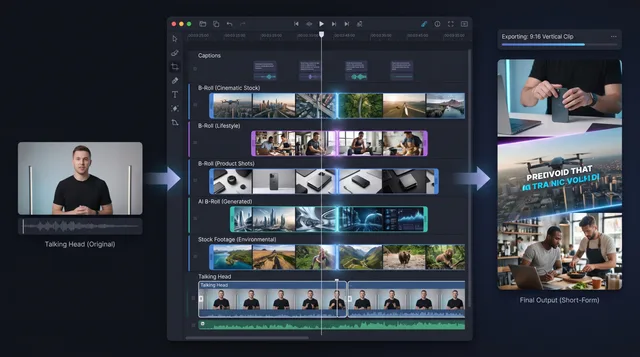
Editing is its own batch. Cutting five clips in a row is far faster than cutting one per day because you stay in the software's rhythm and reuse the same captions, fonts, and templates.
Step 5: Schedule, then leave room
Schedule your batched clips across the week. Deliberately leave one or two slots open for reactive content. This is the release valve that keeps your feed feeling current without demanding daily filming.
A sample week you can steal
Here's what a realistic hybrid week looks like for a solo creator posting Monday through Friday.
Sunday    – Plan + script all clips (60 min)
Monday    – Batch-film 4 evergreen clips (3 hrs)
Tuesday   – Batch-edit all 4 clips + schedule (2-3 hrs)
Wed–Fri   – Post scheduled clips; engage with comments
Any day   – Film 1 reactive clip if a trend lands (30 min)
Notice how the heavy work lives on two days. The rest of the week is light — engagement, monitoring, and the optional reactive clip. That breathing room is exactly what makes the schedule survivable long term.
How to know which model fits you
Ask yourself three questions.
Does my content expire quickly? If your value is timely commentary, lean daily or keep a large reactive slot. If you teach or entertain with evergreen ideas, batch aggressively.
How reliable is my week? If your schedule is chaotic — a day job, kids, travel — content batching is your friend. A buffer of pre-made clips means one bad day won't break your streak.
Where does my energy peak? Some people thrive in long deep-work sessions; others burn out and prefer small daily reps. Match the workflow to your actual temperament, not the one that sounds most disciplined.
Common batching mistakes to avoid
Even committed batchers sabotage themselves. Watch for these:
- Batching too far ahead. Filming a month at once feels efficient until your messaging shifts and half the clips no longer fit. Two weeks is a safe ceiling for most niches.
- Skipping the buffer. If you post everything you batch immediately, you have no safety net. Aim to stay at least a few days ahead.
- Filming without scripts. Improvising ten clips in a row leads to rambling and re-shoots. Scripts keep batch sessions fast.
- One giant unrealistic session. If a four-hour batch day never happens because it's too big, split it into two smaller blocks. Consistency beats intensity.
The bottom line
Batch or daily isn't really a binary. Content batching gives you efficiency, consistency, and a buffer against the chaos of real life, while daily production gives you freshness and reactivity. The strongest short-form workflow borrows from both: batch the evergreen majority, keep a reactive slot open, and let a simple weekly content plan tie it together.
Start with the sample week above. Batch your next four clips in one session, schedule them, and leave one slot open. After two weeks you'll know from experience — not theory — exactly where your ideal balance sits.