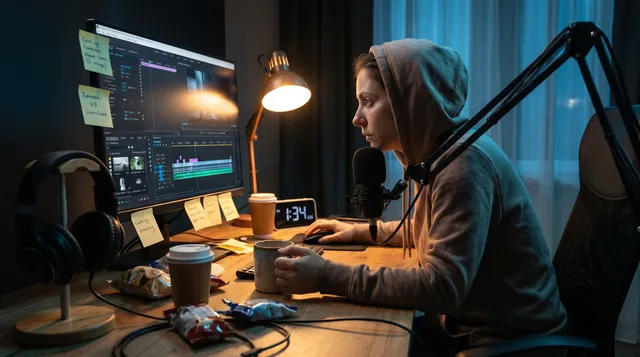
The quickest route is small-batch content testing. Ship three to five rough short-form variations, each changing one variable, instead of a single expensive produced video. Watch retention and shares rather than views, drop the losers fast, and only scale a format into a big production once the experiments prove it earns it.
When you want to know whether a new idea works on camera, the urge is to go big: script it, light it, hire an editor, and ship one polished hero video. That urge leads you astray. The fastest way to test a new video format is content testing through small batches — three to five rough variations shipped quickly — not one costly production you've staked the month on.
Here's why it matters: formats fail for reasons no planning doc can foresee. The hook falls flat. The pacing drags. The topic just doesn't connect. One big video gives you a single data point. Five small ones give you a pattern.
Why one big video is the slow path
A fully produced video feels like real progress. It's expensive, it's shiny, and it eats weeks of work. As a learning tool, though, it's almost useless.
Here's the catch. When you pour effort into a single asset, you've folded dozens of variables into one result. If it underperforms, you can't tell which part failed:
- Was it the format itself, or just this topic?
- Did the hook lose people, or was the length off?
- Is the audience uninterested, or did the thumbnail hide it?
You can't isolate a thing. And because it cost so much, you're emotionally attached to calling it a win. That's how teams keep repeating a format that never really worked.
The big-video approach carries a rough feedback delay too. By the time it's edited, scheduled, and has pulled in enough views to judge, weeks have slipped by. In that window you could have run several rounds of experiments.
Content testing with small batches
The alternative is to treat a new format as a hypothesis and run cheap experiments against it. Content testing means shipping deliberately rough versions, measuring how they do, and letting the data point you toward what to scale.
The mindset shift is simple: your goal isn't to make a great video yet. Your goal is to learn whether this format deserves a great video. Those are two different jobs, and mixing them up is what slows creators down.
What a small batch looks like
A batch is three to five quick cuts of the same format, each changing one thing. Keep production bare — phone camera, natural light, no fancy edit. You're buying information, not Emmys.
| Element | Big-video approach | Small-batch approach |
|---|---|---|
| Assets per test | 1 | 3–5 |
| Production time | 2–4 weeks | 1–3 days |
| Cost per asset | High | Near zero |
| Variables tested | Many at once | One per clip |
| Time to signal | Weeks | Days |
| Cost of failure | Painful | Trivial |
Ship five variations and the winners and losers sort themselves out fast. You're not guessing which element mattered — you built the test so each clip isolates one.
Pick one variable per clip
The discipline that makes batches work is changing only one thing at a time. If every clip differs in five ways, you're back to the one-video problem, just bigger.
Good variables to isolate:
- Hook style — question vs. bold claim vs. visual cold open
- Length — 15 seconds vs. 45 seconds vs. 90 seconds
- Topic angle — same format, different subjects
- Pacing — fast cuts vs. single take
- On-screen text — captions vs. none vs. big kinetic type
Run one batch that varies hooks and keeps everything else fixed. The next batch varies length. Stack the winners together over time.
Why short-form experiments are the ideal test bed
Short-form is where this method really shines. It's cheap to produce, fast to watch, and platforms keep surfacing it to new viewers — so you get a clean read from people who don't already follow you.
Short-form experiments give you three advantages a long video can't:
- Speed. You can shoot a batch in an afternoon.
- Reach to strangers. Algorithmic feeds push short clips to cold audiences, so your data isn't skewed by loyal fans who'll watch anything.
- Clear metrics. Retention curves and average watch time show you exactly where people drop off.
That last point is the real gift. A short-form retention graph shows you the precise second viewers leave. If 60% drop in the first three seconds, your hook is broken — no interpretation needed. A produced long video rarely hands you a diagnostic that plain.
Even if your end goal is long-form or a different platform, short-form experiments are a solid proving ground for the underlying format idea. Test the concept cheaply, then scale the winner into the bigger production.
How to run your first batch
Here's a concrete process you can start this week.
Step 1: Write down the hypothesis
Before shooting, finish this sentence: "I believe [format] will work because [reason], and I'll know it's working if [metric]." Being specific keeps you from moving the goalposts later.
Step 2: Produce five rough cuts
Spend no more than a few hours total. Resist the urge to polish. A good test clip looks like a draft — that's the whole point. If it takes a week, you've already lost.
Step 3: Ship them spaced out
Post over several days, not all at once, so each clip gets a fair shot in the feed. Keep posting times and days roughly consistent to cut down on noise.
Step 4: Read the right metrics
Views are the loudest number and the least useful. Lean on these instead:
- Retention / average watch time — are people actually watching?
- Hook rate — what percent make it past the first 3 seconds?
- Shares and saves — the strongest signal of real value
- Follower conversion — did a new viewer stick around?
Step 5: Decide, then iterate
After a batch, you'll land in one of three places:
- Clear winner — one variable obviously outperformed. Scale it and test the next variable.
- Mixed signal — results are close. Run one more batch with sharper variations.
- Flat failure — nothing landed. Good. You learned the format's dead for cheap, and you're free to try something else.
That third outcome is a feature, not a bug. The whole value of content testing is killing bad ideas before they cost you weeks.
Batch Test Template

Hypothesis: ____________________
Format: ________________________
Variable tested: _______________

Clip 1 — variation: _______  | retention: ___ | shares: ___
Clip 2 — variation: _______  | retention: ___ | shares: ___
Clip 3 — variation: _______  | retention: ___ | shares: ___
Clip 4 — variation: _______  | retention: ___ | shares: ___
Clip 5 — variation: _______  | retention: ___ | shares: ___

Winner: ________________________
Next variable to test: _________
Common mistakes that ruin a test
Even with the right method, a few habits quietly undermine your results.
Over-producing the test clips. The moment you spend a full day editing one "test" video, you've walked right back into the sunk-cost trap. Keep them rough on purpose.
Changing too many things at once. If clip two has a new hook, new topic, and new music, a win tells you nothing. One variable per clip.
Judging too early. Give each clip at least 48–72 hours. Short-form distribution arrives in waves, and some clips find their audience late.
Trusting vanity metrics. A clip with huge views but 20% retention is a worse format signal than a modest clip people watch to the end and save.
Testing in isolation forever. Testing is a means, not an identity. Once a format proves itself, commit to it and build the bigger production. The batch was the scaffolding, not the house.
When a big production finally makes sense
None of this means polished video is wrong. It means polish comes after the format is validated, not before.
Once content testing has confirmed the hook, the length, and the angle that work, pouring resources into a high-production version is a smart bet — because you're amplifying something you already know performs. The guesswork is gone. The expensive video becomes the deployment of a proven idea, not a gamble.
Think of it as a funnel:
- Short-form experiments validate the raw concept cheaply.
- Batches isolate the specific choices that make it work.
- Production scales the winner for maximum impact.
Skipping straight to step three is the slow, expensive mistake. Running the batches first is almost always the faster path to a working format — even though it feels like more individual pieces of work.
The takeaway
The fastest way to test a new video format isn't to make the best possible video. It's to make the cheapest possible experiments and let the results guide you.
Ship small batches. Vary one thing at a time. Use short-form experiments to get fast, honest signal from real viewers. Read retention over views. Kill losers early and scale winners hard. Do this consistently and format discovery turns from a slow guessing game into a repeatable system — and that system compounds every time you run it.