The biggest content repurposing mistake is reposting untailored content across platforms — same caption, watermark, and format everywhere. Algorithms penalize recycled, off-platform content, crushing your reach. Fix it by tailoring each piece to the platform's native format, tone, and aspect ratio, then publishing directly to each platform rather than cross-posting.
You did everything right. You made a great video, cut it into clips, and pushed it to every platform you're on. Then you watched the numbers come in — and they were flat everywhere except the one place you originally posted it.
Sound familiar? The problem usually isn't your content. It's how you're repurposing it. Specifically, it's the single most common content repurposing mistake creators make: taking a finished post from one platform and dropping it, untouched, onto another.
That one habit does more damage to your reach than a bad thumbnail, a weak hook, or an off-day for the algorithm. Let's break down why — and exactly how to fix it.
The mistake: reposting untailored content
Repurposing is supposed to multiply your effort. Make once, distribute everywhere. The logic is sound. The execution is where most creators fall apart.
The mistake is treating repurposing as a copy-paste job. You export the TikTok, upload it to Reels and Shorts with the same caption, the same watermark, the same aspect ratio, and the same first three seconds — and you expect three platforms to reward it equally.
They won't. Every platform is a different room with a different crowd, different unspoken rules, and a different algorithm deciding who gets to hear you. Walking into all three and giving the identical speech gets you ignored in at least two.
Why platforms punish recycled content
Algorithms are built to keep people on the platform. Content that clearly originated somewhere else — a competitor's watermark, a caption written for a different audience, a format that feels borrowed — signals low effort and off-platform intent. That's the opposite of what any feed wants to promote.
Instagram has openly deprioritized Reels with visible TikTok watermarks. YouTube Shorts favors content that feels made for Shorts. The pattern is consistent: platforms reward creators who show up like locals, not tourists passing through.
Why untailored repurposing crushes social media reach
When your reach tanks after cross-posting, a few invisible forces are working against you at once.
The watermark tax. A logo from another app is the clearest possible tell that content is recycled. It caps distribution before your video even has a chance to perform.
The context mismatch. A hook that crushed on LinkedIn — text-heavy, professional, slow-building — dies on TikTok, where you have roughly one second to earn a scroll-stop. Same idea, wrong delivery.
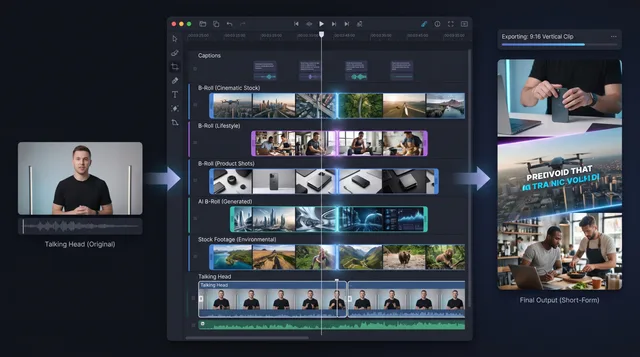
The format penalty. Post a horizontal clip with letterboxing on a vertical-first platform and you've told the algorithm you didn't bother. Aspect ratio, captions, and safe zones all vary, and getting them wrong looks lazy to both viewers and the ranking system.
The early-signal problem. Most platforms test your content on a small audience first. If those first viewers don't engage — because the content feels foreign to them — the algorithm stops there. Your reach is decided in the first few minutes, and untailored content fails that test constantly.
The frustrating part is that none of these are content-quality problems. Your idea might be excellent. It's the packaging that's costing you social media reach.
What tailored content repurposing actually looks like
Tailoring doesn't mean remaking everything from scratch. That would defeat the entire point. It means adapting the surface layer while keeping the core idea intact.
Here's the difference between lazy repurposing and smart repurposing:
| Element | Lazy repurposing | Tailored repurposing |
|---|---|---|
| Aspect ratio | One ratio everywhere | Vertical for TikTok/Reels/Shorts, square/horizontal where it fits |
| Watermarks | Left on from source app | Removed or re-exported clean |
| Caption | Identical text pasted | Rewritten for each platform's tone |
| Hook | Same first 3 seconds | Re-cut to match platform pace |
| Hashtags/keywords | Copied or ignored | Platform-specific and current |
| Length | Whatever the original was | Trimmed to each platform's sweet spot |
Notice that the message never changes. You're not creating new content — you're translating one piece into each platform's native language.
A quick tailoring checklist
Before you publish a repurposed piece anywhere, run through this:
- Is the aspect ratio correct for this platform?
- Are all foreign watermarks and logos removed?
- Does the caption speak to this audience in this platform's tone?
- Is the hook re-cut to grab attention within the first second or two?
- Are captions/subtitles burned in where the audience watches on mute?
- Are hashtags and keywords specific to where you're posting?
Five minutes of this beats an hour of making brand-new content that nobody sees.
Native publishing: the fix hiding in plain sight
The most reliable way to avoid the untailored-content trap is native publishing — uploading content directly to each platform in the format that platform expects, rather than linking out or auto-syndicating from one central place.
Why native uploads win
Platforms want to keep users inside their walls. Content that lives natively — a video uploaded straight to LinkedIn instead of a YouTube link, a Reel filmed and captioned for Instagram — keeps people from leaving, so the platform pushes it harder.
The reach gap is not subtle. Native video routinely outperforms shared links by a wide margin because the algorithm has every reason to promote content that keeps eyeballs on-site and no reason to promote content that sends them away.
Native publishing also unlocks platform-specific features: TikTok's on-screen text and sounds, Instagram's stickers and collabs, LinkedIn's document carousels, YouTube's chapters and end screens. Those features aren't decoration — they're engagement tools the algorithm actively rewards.
Native publishing in practice
For each platform, ask what "native" means there:
- TikTok: trending sounds, fast cuts, on-screen captions, casual tone.
- Instagram Reels: clean vertical video, no competitor watermarks, engaging cover frame.
- YouTube Shorts: strong hook, looping potential, Shorts-native pacing.
- LinkedIn: value-first captions, uploaded video or native carousels, professional framing.
- X: concise text, native video, threads that stand alone.
Same source idea. Five genuinely native expressions of it.
A realistic repurposing workflow
You don't need to spend your whole day on this. A tight system turns tailoring into a fast, repeatable step.
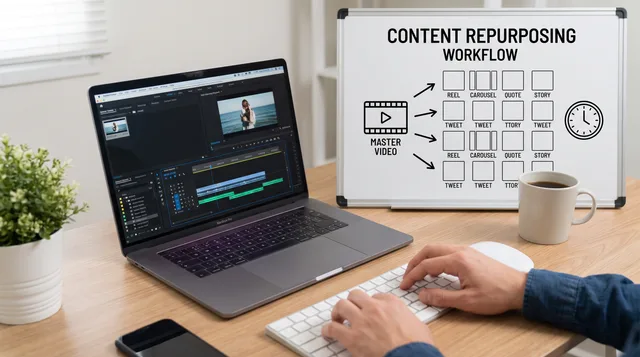
- Create one strong pillar piece. A long video, a podcast episode, a detailed post — something meaty enough to break apart.
- Identify the reusable core ideas. Pull the three to five moments or points that can stand alone.
- Choose target platforms per idea. Not everything belongs everywhere. Match the idea to the audience.
- Tailor the surface for each. Re-crop, re-caption, re-hook, strip watermarks. Use the checklist above.
- Publish natively on each platform. Upload directly, use native features, and post at the right time for that audience.
- Read the signals and iterate. See which tailored versions land, then double down on what the data shows.
The pillar-to-pieces model means your effort compounds instead of scattering. One good idea becomes a week of native content — each version built to win in its own room.
Common objections (and honest answers)
"Isn't tailoring every post too much work?" It's less work than making original content for every platform, which is the alternative if you want reach. Tailoring is the middle path: one idea, light adaptation, big payoff. Most edits take a few minutes once you have a template.
"Some creators cross-post everything and still blow up." A few do — usually because they already have massive existing audiences that engage regardless. For everyone still building, the algorithm's early-signal test is unforgiving, and tailored content passes it far more often.
"Can't I automate this?" You can automate parts — captioning, resizing, watermark removal, scheduling. But automation should serve tailoring, not replace it. The goal is native-looking content published efficiently, not identical content blasted everywhere.
The mindset shift that fixes your reach
Stop thinking of content repurposing as distribution and start thinking of it as translation.
A translator doesn't hand a French reader an English book and call it a day. They rework the phrasing, idioms, and rhythm so the meaning lands naturally in the new language — while keeping the story exactly the same. That's your job across platforms.
The creators who quietly dominate multiple platforms aren't producing five times more content than you. They're producing one strong idea and translating it fluently into each platform's native tongue. That's the whole game.
The repurposing mistake killing your reach isn't that you repurpose. It's that you repurpose untailored. Fix the packaging, publish natively, and watch the same ideas that flopped start reaching the audiences they always deserved.
The one-line takeaway
Repurpose the idea, never the artifact. Rebuild the surface for every platform, upload it natively, and your reach stops being a mystery.